

Ecommerce Website Cost: How Much Does an Ecommerce Website Cost in 2026?
category /
Branding
date published /
10.03.26
read time /
10min
Why is it so hard to give out ballpark numbers for ecommerce website costs? The honest answer is, well, it depends. You could expect to fork out as low as a few hundred bucks but also see costs balloon into the six figures for fully-customisable bespoke setups designed to scale. So really, the question shouldn’t be “how much will this set me back?” but “how much will it cost me to scale my business?”. Anyway, here’s our helpful guide:
Ecommerce is also becoming a larger share of global retail. According to EMARKETER, online sales are expected to account for 20.5% of worldwide retail sales in 2025, continuing a steady upward trend as more consumers shop online. As ecommerce grows, businesses increasingly rely on scalable and high-performing online stores, making ecommerce website development a strategic investment rather than just a technical expense.
Why Ecommerce Website Cost Matters More Than You Think
It’s easy to get hung up on the upfront store building costs, only to get blindsighted by all the extras that come along down the line: monthly subscription fees, transaction charges, plugin costs, agency retainers, and security updates all add up pretty fast. So, if you decide to go for a template builder like, say, shopify, the advertised $29/month can quickly end up as $1,500/month in your credit card statements.
But let's put a pin in the cost discussion for a second, and focus on scalability. The decisions you make when you’re first conceiving of your online store can ensure that it continues to grow to keep meeting your business demands.Template-based websites all eventually hit a ceiling for scalability or customisability, for example. That’s how you avoid lost revenue and migration expenses that you thought you saved by skipping on the higher initial cost.
Key Factors That Determine Ecommerce Website Cost
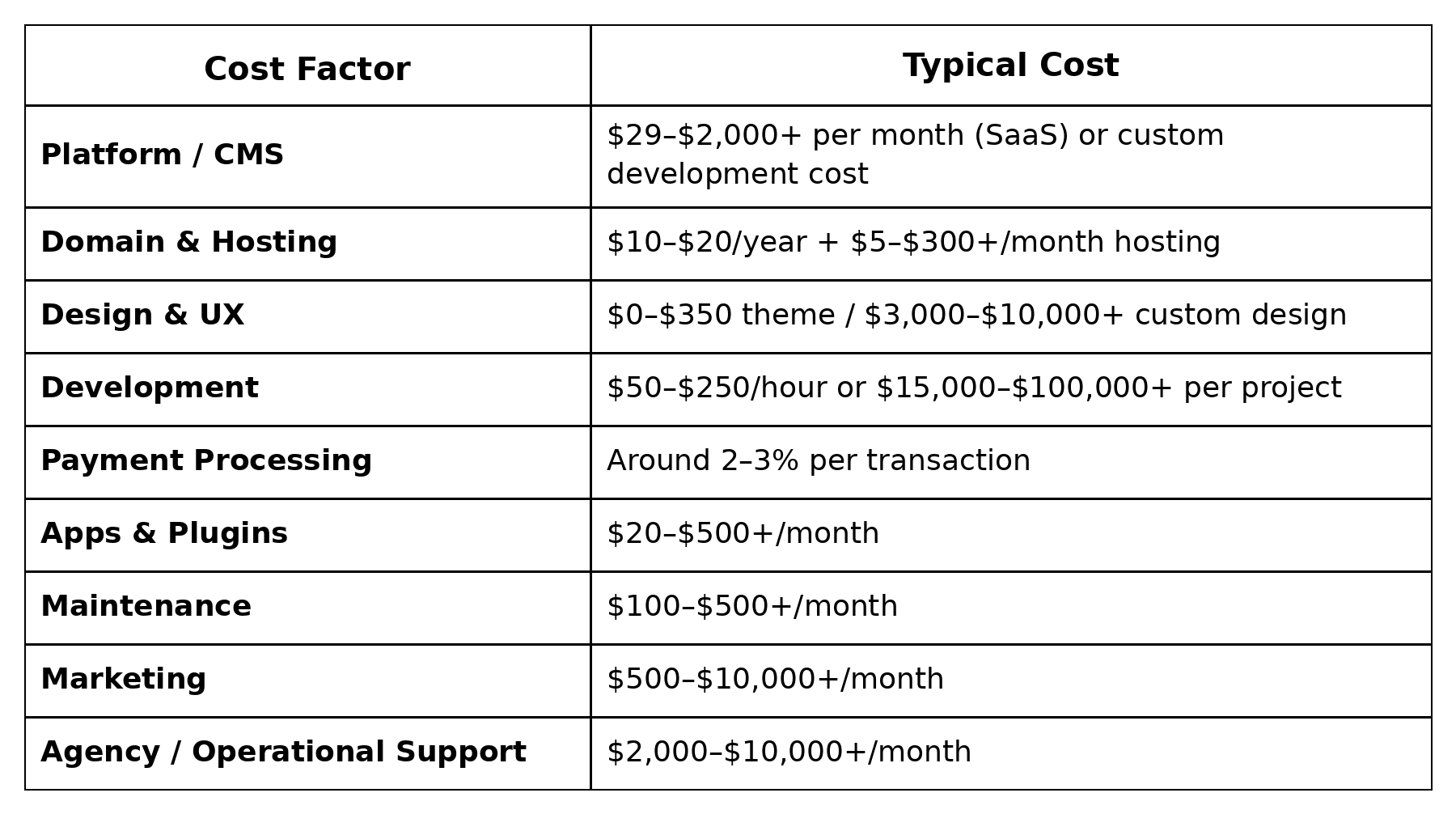
Unsurprisingly, ecommerce website cost is never about a single line item. Here are a few bullet points to really illustrate what we mean by that:
- 1)
Platform fees vs custom code: SaaS platforms (Shopify, BigCommerce) carry recurring fees, transaction cuts, and customization limits. Custom-coded sites like the ones we offer eliminate those ongoing costs and give you full control over functionality and brand experience.
- 2)
Hosting & domain: Domains run $10–$20/year. Hosting ranges from $5/month on shared servers to several hundred on managed cloud infrastructure. SaaS platforms usually bundle this in but custom builds require you to choose and manage it separately.
- 3)
Design complexity & UX: You could expect to pay anywhere between nothing to $350 for a pre-built theme, while a custom studio design will start at $3,000 and easily surpass the $10,000 mark. The key marker of difference here is UX quality. Better UX means better click-through conversion rates, and thus the difference between a struggling and profitable site.
- 4)
Development (front-end/back-end, integrations): If you plan on going the freelancer route to develop a site, expect to pay $50 to $150/hour, or up to $250/hour for an agency. An agency will quote a round $15,000 to $100,000 charge depending on scope and integrations.
- 5)
Payment processing & security: Unless you own your own bank, you’d have to go through a processing service like stripe, which charges about 3% per transaction. Expect much higher expenses for custom platforms.
- 6)
Apps, plugins, automation tools: Yeah, those cost money too. Email, reviews, loyalty, upsells, SEO…each one carries a monthly fee.
- 7)
Maintenance & optimisation: Security patches, bug fixes, and performance work are ongoing. You should budget up to $500/month on this one, but as you can expect: custom builds also cost more to maintain.
- 8)
Marketing stack: So that’s a marketing budget expense, as the title suggests, but still. Paid ads, SEO, email, and content each carry their own costs.
- 9)
Staff or agency support: A growing brand typically spends $2,000–$10,000/month on external support like operations, customer services and so on.
Tips for Choosing the Right Ecommerce Website Budget
- 1)
Start with your business goals, not a feature list. Ask what revenue targets you need to hit in 12 months, and work backward to understand what capabilities your site actually needs to support that.
- 2)
Prioritise scalability and UX over cheap templates. A template that "does the job" today will limit your growth tomorrow. Conversion-optimised design and fast load times are revenue drivers, not optional extras.
- 3)
Consider custom ecommerce development for unique branding and flexibility. If your brand depends on standing out, a cookie-cutter template will always work against you. Custom code gives you a site that's uniquely yours; and built to perform.
- 4)
Account for long-term hidden costs. Apps, integrations, security, optimization, and maintenance are real budget lines that need to be planned for, not discovered after launch.
- 5)
Budget for growth, not just launch. The most expensive mistake in ecommerce is building a site that requires a complete rebuild 18 months in because it can't handle your traffic or your catalog size.
Mistakes to Avoid When Calculating Ecommerce Website Cost
These are the most common and costly calculation errors businesses make when budgeting for an ecommerce website:
- 1)
Focusing only on platform fees.
The monthly platform subscription is often the smallest part of your real total cost. Transaction fees, app stacks, and support costs frequently dwarf the base subscription price.
- 1)
Ignoring UX and conversion optimisation.
A beautiful product that no one can find or checkout from is a liability, not an asset. UX investment pays for itself rapidly through improved conversion rates.
- 1)
Over-customizing too early.
Startups sometimes spend tens of thousands on features they don't need yet. Build for what you need now with a platform that can expand rather than a feature set you're guessing at.
- 1)
Forgetting ongoing maintenance.
A live ecommerce site requires constant care. Ignoring maintenance leads to security vulnerabilities, degraded performance, and ultimately, lost customers.
Choosing templates when code-based solutions offer better scalability. Templates feel like the safer, cheaper choice, but for businesses with real growth ambitions, the limitations of template-based sites often become the biggest obstacle to scaling.
Ecommerce Website Cost Examples
- 1)
Starter Ecommerce Store: ~$500 – $2,000/year, DIY or small agency, template-based or minimal code.
Who it's for: Solo founders, side businesses, early-stage DTC brands with limited SKUs.
This tier typically involves a DIY setup on Shopify Starter, WooCommerce on shared hosting, or a similar entry-level platform. Design is template-based with minimal customization. The main costs are platform subscription, domain, and a handful of free or low-cost apps. The trade-off: limited flexibility, no custom branding, and a ceiling you'll hit sooner than you expect if the business takes off.
- 1)
Growing Ecommerce Brand: ~$5,000 – $20,000/year, includes apps, optimization, partial custom code.
Who it's for: Brands with proven product-market fit, $500K–$5M in annual revenue, growing marketing spend.
At this stage, businesses are typically on a mid-tier Shopify or BigCommerce plan with several third-party apps, professional design, and some custom development work. They may work with a freelancer or small agency for ongoing support. The app stack grows significantly here through things like email platforms, review tools, loyalty programs, and analytics integrations, all adding monthly costs. This is also where businesses start running into platform limitations and wondering if a custom build makes more sense.
- 1)
Advanced / Custom Ecommerce: ~$30,000 – $150,000+, full custom-coded site (your service), multi-region, full integrations.
Who it's for: Established brands, multi-region retailers, B2B ecommerce, or any business where the website is a core competitive asset.
This is where fully custom-coded ecommerce development lives. The site is built from the ground up. This means no templates, no platform constraints, no recurring app fees eating into margin. Custom development at this level includes bespoke UX design, complex back-end integrations (ERP, CRM, custom checkout logic, multi-currency support), high-performance front-end architecture, and a deployment infrastructure built for serious traffic. Ongoing maintenance and optimization is handled by a dedicated agency relationship. The upfront cost is substantial, but for businesses at this level, the ROI is clear: a faster, more flexible, more on-brand site that doesn't require a rebuild every time you want to grow.
How to Get the Best Value from Your Ecommerce Website Investment
- 1)
Cost-optimisation and value-maximisation are different things. Here's how we make sure every dollar you spend on your ecommerce website is working for you:
- 2)
Focus on ROI, not the cheapest price. A $50,000 custom ecommerce site that converts at 4% will outperform a $5,000 template site that converts at 1% every time, at any meaningful traffic volume. Think in terms of revenue per visitor, not cost per page.
- 3)
Choose code-based development for flexibility, speed, and brand uniqueness. Custom code lets you build exactly what your business needs. No workarounds, no limitations, no dependency on a third-party platform's roadmap. It's also significantly faster to load, which directly affects both conversion rates and SEO performance.
- 4)
Balance upfront investment vs. long-term maintenance. A cheaper site that requires constant patching, workarounds, and agency hours to maintain may cost more over three years than a well-built custom site that runs reliably.
- 5)
Invest in conversion-optimized UX and mobile-first design. Over 60% of ecommerce traffic now comes from mobile. A site that isn't optimised for mobile isn't just missing revenue. It's actively creating friction for the majority of your potential customers.
Conclusion — The Real Cost Isn’t the Price Tag, It’s the Decisions You Make
There's no single right answer to how much an ecommerce website costs. The right answer is the one that matches your business stage, your growth ambitions, and your willingness to invest in what actually drives revenue rather than just checking a box.
Template sites are fine for getting started. But for businesses serious about brand, performance, and long-term scalability, custom-coded ecommerce development is consistently the higher-value investment, even when the upfront cost is higher. You get a site that's faster, more flexible, more distinctly yours, and built to grow without hitting walls.
The businesses that win in ecommerce aren't necessarily the ones that spend the most. They're the ones that are spent wisely: on the right foundation, the right design, the right development partner, and the right long-term strategy.
If you're evaluating your options and want to understand what a custom-coded ecommerce solution would look like for your business, explore our ecommerce experience and get in touch to talk through the right approach for your stage and goals.
by
Anginé Pramzian
read next

subscribe to newsletter